

BMW is starting production of the new i3 this month with a claim that is less spectacular than range, acceleration, or charging speed, but potentially more important for the future of the car industry.
Its Neue Klasse electronics architecture cuts around 600 meters of wiring and concentrates much of the car’s computing power in just four central “superbrains”.
It is also another sign that Europe’s automotive old guard has absorbed a lesson first demonstrated by Tesla and subsequently accelerated by Chinese EV makers.
Building an electric car efficiently requires more than replacing the combustion engine with a battery and motors. The entire electronic architecture has to be simplified, with fewer separate controllers, shorter wiring runs, and much more software concentrated in central computers.
Farley learned a lesson from Tesla
Ford CEO Jim Farley has described discovering exactly that problem when his engineers benchmarked Tesla and Chinese EVs, while BMW has now rebuilt its Neue Klasse around the same basic philosophy.
BMW says the Neue Klasse architecture uses around 600 meters less cable than the previous generation and reduces wiring-harness weight by 30%.
The car is divided into physical zones, with sensors and actuators connected to nearby controllers rather than requiring individual wiring runs throughout the vehicle.
Above them sit four high-performance computers BMW calls “superbrains”. They handle driving dynamics, automated driving and parking, infotainment, and basic comfort and body functions. Together, they offer up to twenty times the computing power of BMW’s previous systems.
Not all ECUs replaced
The four superbrains do not simply replace every electronic control unit, or ECU, in the car. Dedicated controllers remain necessary for components such as the battery, power electronics, charging equipment, sensors, and actuators. BMW also retains simpler zone controllers to connect those components with the central computers.
What changes fundamentally is where the intelligence resides. Functions that were previously distributed over numerous separate supplier-developed ECUs are increasingly concentrated in the four central computers.
BMW does not disclose exactly how many traditional ECUs disappear, so it would be misleading to say that four computers replace 100 control units. The Heart of Joy computer alone, however, combines drivetrain, braking, recuperation, and chassis-control functions that previously required several separate controllers.
That consolidation matters because a modern car can contain well over 100 ECUs. And electrification does not necessarily make the situation simpler.
A conventional combustion car needs controllers for its engine, gearbox, emissions systems, safety, comfort, infotainment, and increasingly sophisticated driver assistance.
PHEV most complex
A hybrid retains almost all of those systems but adds a high-voltage battery, electric motor, inverter, and hybrid supervisory control. A plug-in hybrid adds charging electronics and more elaborate high-voltage and thermal management on top.
In electronic terms, a PHEV can therefore be more complex than either a conventional combustion car or a clean-sheet battery-electric vehicle.
A BEV dispenses with engine management, exhaust after-treatment, and the conventional transmission, but adds battery management, traction inverters, charging electronics, and high-voltage thermal control.
Whether it ultimately needs 70, 100, or more control modules increasingly depends less on its propulsion system than on the design of its electronics architecture.
What Neue Klasse attempts to change
The lesson is becoming common across the industry. Traditional cars contain an astonishing amount of wiring and a multitude of separate electronic controllers.
Every extra cable adds cost, weight, assembly work, and complexity. The move toward software-defined vehicles is therefore not only about screens, apps, and artificial intelligence. It is also about radically simplifying the car’s physical nervous system.
Ford CEO Jim Farley learned that lesson the hard way. When Ford engineers benchmarked Tesla, they discovered that the Mustang Mach-E’s wiring harness was around 1.6 kilometers longer and roughly 32 kg heavier than the more efficiently engineered rival architecture.
Farley later said the discovery left him “flabbergasted” and exposed how much Ford’s first-generation EVs had inherited from traditional car-development thinking.
Cutting 1.2 km of wiring
Ford has since gone back to the drawing board. Its new Universal EV Platform, which is to underpin a new generation of affordable electric vehicles, uses more than 4,000 feet, around 1.2 kilometers, less wiring than Ford’s first-generation electric SUV. The new harness is also around 10 kg lighter.
That sounds more dramatic than BMW’s 600-meter saving, although the figures cannot be directly compared because the companies use different vehicles and architectures as their baselines. What they demonstrate is the same engineering trend.
For Farley, the wiring loom became a symbol of a much bigger competitive problem. He has repeatedly warned that Tesla and especially Chinese EV manufacturers entered the electric-car era with fewer assumptions inherited from combustion-engine cars.
His fascination with Xiaomi has become almost symbolic of that awakening. Farley had a Xiaomi SU7 imported from Shanghai to Chicago and drove it for months, famously saying he did not want to give it up.
Ford has also systematically dismantled Chinese EVs to understand how their manufacturers achieve lower costs, tighter electronics integration, and faster software development.
The Chinese have been moving forward for years
That makes it more difficult to judge claims that BMW has now taken the lead in software-defined vehicles. Chinese manufacturers have been moving toward centralized computing for years.
XPeng introduced its X-EEA 3.0 architecture, featuring central supercomputing, local controllers, and Gigabit Ethernet, before Neue Klasse reached production. The company now describes its latest generation explicitly as a “central computing and zonal control architecture”.
Nio has followed a similar path with its SkyOS vehicle operating system and increasingly centralized computing. Its latest models combine enormous processing capacity for assisted driving, the cockpit, and vehicle functions while allowing software and hardware development to become progressively less dependent on each other.
Xiaomi takes a somewhat different route. Its latest cars consolidate assisted driving, the digital cockpit, vehicle control, and telecommunications into a highly integrated domain controller.
It remains more visibly organized around functional domains than BMW’s physical zonal concept, but the objective is similar: fewer boxes, less duplicated hardware, shorter wiring, and greater control over software.
Spreading across the model range
The real value of Neue Klasse may lie not only in fewer wires, but in the way BMW separates software from the underlying hardware.
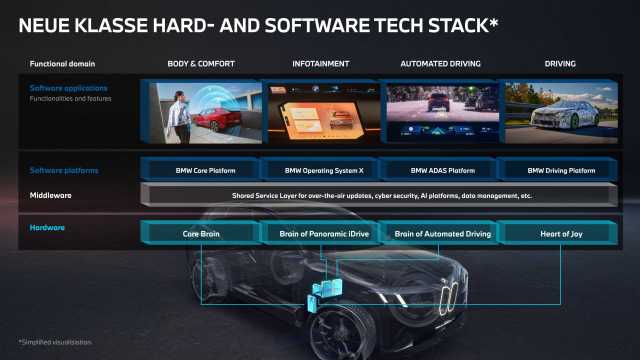
Where BMW may have an advantage is in how comprehensively it has rebuilt the architecture and how broadly it intends to use it. Neue Klasse electronics are not intended to remain confined to a small family of EVs.
BMW wants the technology and software architecture to spread through its model range, allowing software development to become increasingly independent of individual vehicle generations and, eventually, individual hardware components.
That also changes BMW’s relationship with suppliers. In a traditional distributed architecture, much of the software resides in an ECU developed by a Tier 1 supplier for a specific function.
Changing that function can mean returning to that supplier and modifying both hardware and software. Centralized computing gives BMW much greater control over the software layer and potentially makes it easier to change hardware suppliers without rewriting the entire function.
Replacing 150 traditional fuses
Another striking part of the Neue Klasse electrical clean-up is BMW’s introduction of digitally controlled Smart eFuses. They can replace up to 150 traditional fuses and allow individual electrical systems to be switched off depending on whether the car is driving, parked, charging, or receiving a software update.
The real breakthrough is therefore not that BMW has found a clever way to save 600 meters of cable. It is that the company is redesigning the car around a fundamentally different electronics philosophy.


