
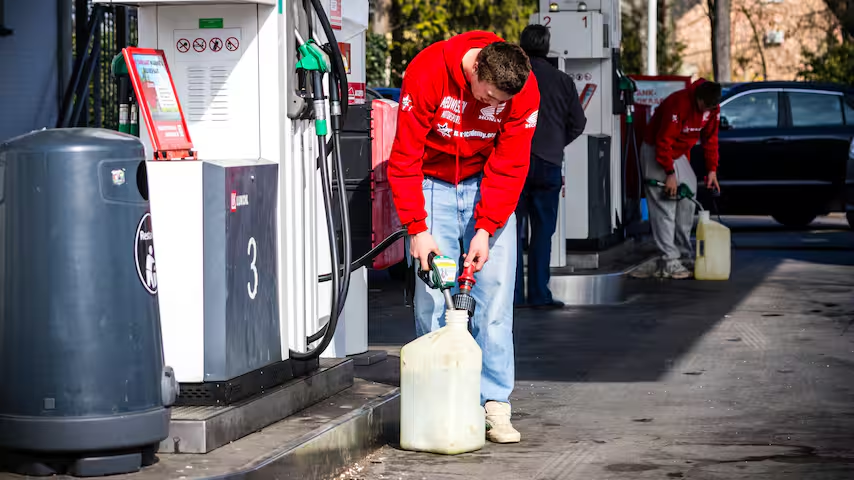
An increasing number of Dutch people living in the border region with Belgium are filling up their tanks in Belgium, according to research by ABN AMRO. By now, approximately 15 percent of gasoline consumption in that region has shifted to Belgium.
The Dutch are flocking to Belgium to fill up their tanks, now that the price difference for gasoline stands at 70 cents per liter – a gap wider than ever before. In Belgium, the maximum price for a liter of gasoline is currently 1.866 euros, compared to 2.599 euros per liter in the Netherlands.
However, the Dutch figure is not the average price motorists actually pay, but the average national recommended retail price (Gemiddelde Landelijke Adviesprijs, GLA), based on the recommended prices of the major oil companies. On August 6, that advisory price stood at €2.578.
Historically exceptional
The European Commission’s same-date comparison for 3 August put average Euro 95 at approximately €1.883 in Belgium and €2.370 in the Netherlands. So, the representative gap was therefore just under 49 cents (48.7 to be precise) per liter, rather than 70 cents, which, of course, is still enormous.
The present gap is historically exceptional, and 2026 is on course to have the largest annual average difference in the series, but this particular week is not an absolute record. The spectacular 70-cent figure only emerges by comparing a Belgian maximum price with a Dutch oil-company advisory price.
But why are Dutch prices so much higher?
Dutch gasoline excise this year is 84.5 cents per liter, while Belgium levies approximately 60 cents. Both countries apply 21% VAT. The direct excise difference is consequently around 24.5 cents, only about half the current retail-price gap.
There is also a structural difference in pricing. Belgium operates a maximum-price mechanism. Stations may charge less, particularly away from motorways. The Netherlands has no equivalent ceiling, while motorway stations and branded sites often remain close to the high advisory price.
Queuing in border hotspots
Belgian stations in border hotspots such as Meerle, Essen, Zelzate, and Baarle-Hertog have reported queues, more frequent tanker deliveries, and traffic problems. Some municipalities have even appointed stewards to manage fuel tourism.
The effect of fuel tourism in the Netherlands is visible up to approximately 30 kilometers from the Belgian border. However, the observation that half the Dutch are ‘massively’ filling up in Belgium is exaggerated and cannot be extrapolated to the Netherlands as a whole.
Some are indeed filling up jerrycans as well, but under the ADR dangerous-goods exemption, a private individual may transport up to 240 liters of fuel in refillable containers, with a maximum of 60 liters per container, provided the fuel is for personal use, and measures are taken to prevent leakage.
Dutch Customs also states that a private individual may bring fuel from another EU member state in the vehicle tank or in a portable reserve can for personal use without paying Dutch excise again. Nevertheless, transporting gasoline inside an ordinary passenger car creates an obvious fire, vapor, and leakage risk.


