
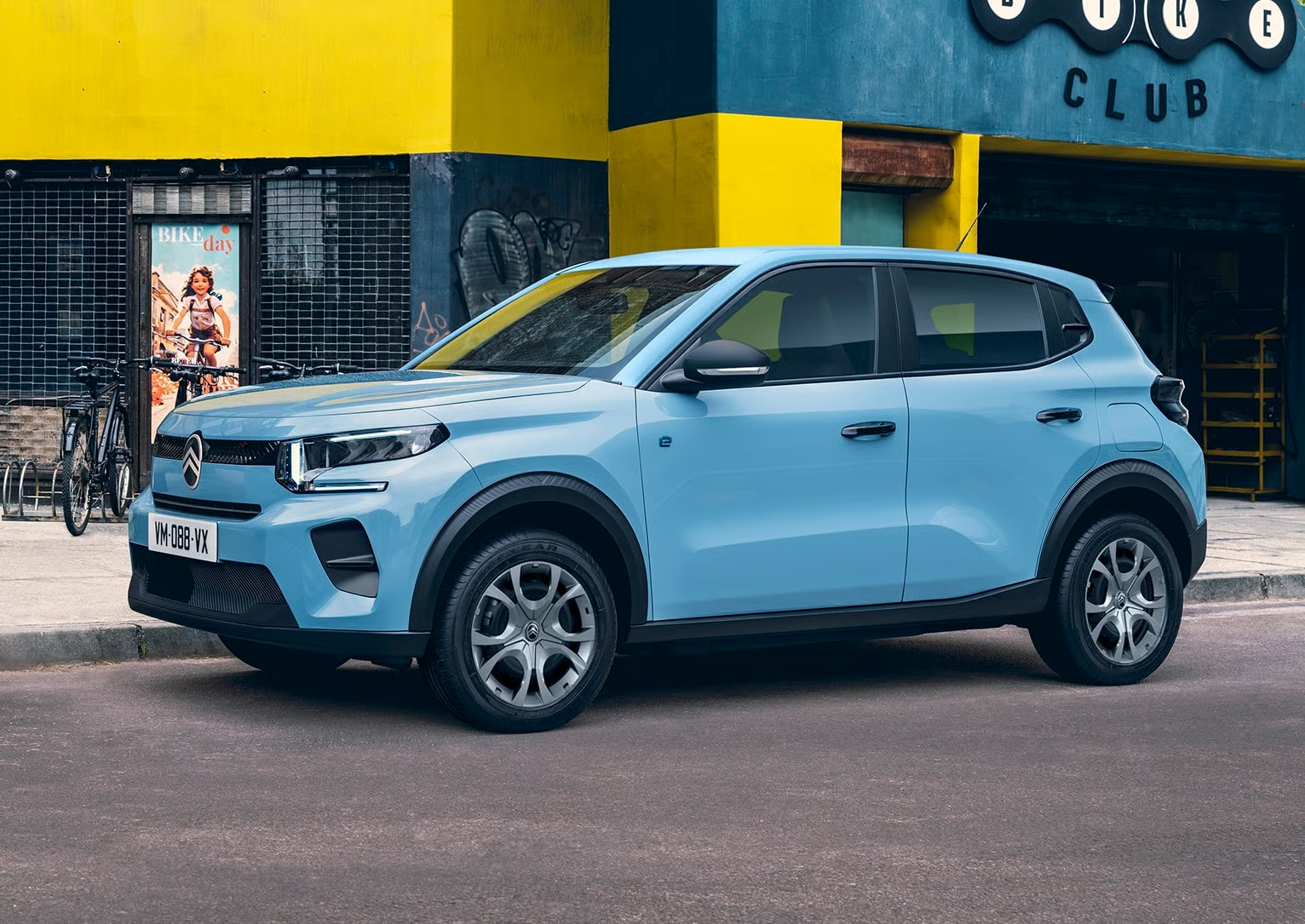
A Dutch study arguing that governments should subsidize electric lease cars for low-income, car-dependent households rather than cut fuel taxes for everyone could also feed the debate in Belgium.
Vooruit and opposition party Ecolo have both proposed versions of French-style social leasing, with EVs available for roughly €100 to €150 per month, but the idea has so far failed to win broader government support.
Belgium could potentially use European social-climate funding to help finance such a scheme, although both its cost and the question of whether public money should subsidize private cars remain politically contentious.
160,000 low-income households
Writing in the Dutch economics journal ESB, researchers Peter Mulder, Rens van Tilburg, and Reinier Sterkenburg estimate that around €1.1 billion could give 160,000 low-income households in the Netherlands that depend heavily on their cars access to an electric lease vehicle.
Their calculation assumes public support of around €7,000 per car. That would still cost less than the broad Dutch fuel-tax reduction introduced in 2022, which costs the government roughly €1.7 billion a year.
The researchers argue that such blanket measures are poorly targeted. Lower-income households spend a much larger share of their disposable income on fuel, but higher-income motorists drive more and therefore capture a disproportionately large share of an across-the-board tax reduction.
At the same time, the households most exposed to rising petrol and diesel prices are often unable to switch to an electric car because of its higher purchase price.
An EV can be cheaper to run thanks to lower energy and maintenance costs, but households with limited savings or borrowing capacity may not be able to make the initial investment. Social leasing is intended to remove that barrier.
France overwhelmed by demand
France has already tested the concept on a large scale. In 2024, it became the first European country to launch a nationwide social-leasing program for electric cars.
The scheme targeted lower-income drivers who depended on a car for work. Instead of paying the subsidy directly to the driver, the government supported leasing companies, reducing or eliminating the large upfront payment normally required at the start of a contract.
That brought monthly lease prices for smaller electric models down to roughly €100-€140.
Demand immediately exceeded expectations. The French government initially expected around 20,000 to 25,000 cars, but closed the first round after roughly 50,000 contracts had been signed because the budget was being used up much faster than anticipated.
A second round followed in 2025, again covering around 50,000 vehicles. The program proved particularly relevant outside major cities. Around 55% of beneficiaries lived in rural areas, where public transport is often limited, and car dependency is much higher.
France has since continued the program, with a third round targeting another 50,000 households and additional incentives for EVs and batteries manufactured in Europe.
The poorest remain difficult to reach
The French experience also shows that social leasing is no silver bullet. Even a €100 monthly lease can be difficult to afford for households at the very bottom of the income scale once insurance, electricity, and other running costs are added. French evaluations found that the lowest-income group remained underrepresented.
Charging is another issue. Drivers who can charge cheaply at home can benefit significantly from the lower running costs of an EV, while those who depend entirely on public charging may save much less.
There is also the question of what happens when the subsidized lease ends. Most French contracts run for at least three years. Customers must then return the car, buy it at its residual value, or find another affordable mobility solution.
Social leasing, therefore, reduces the entry barrier to electric driving, but does not automatically solve transport poverty permanently.
Belgium remains divided
The French model has also entered the political debate in Belgium, although there is no consensus on introducing it.
Vooruit, which sits in both the Flemish and federal governing coalitions, has backed social leasing since late 2025, proposing small electric cars for lower-income households at around €120 to €150 per month.
In April, opposition party Ecolo went further with a pilot scheme for 10,000 EVs at approximately €100 per month, supported by around €7,000 in public funding per car and targeted at lower and middle-income workers who genuinely depend on a vehicle.
The proposal has met resistance. Flemish Mobility Minister Annick De Ridder of N-VA has dismissed social leasing as a “fausse bonne idée” and says it is neither part of the Flemish coalition agreement nor under consideration by her administration.
Coalition partner CD&V was initially willing to examine the French model, but has become more skeptical after seeing its shortcomings. Vooruit nevertheless continues to support the idea.
Wallonia is not planning a similar scheme either, preferring to spend available resources on demand-responsive transport and mobility vouchers for vulnerable households rather than subsidizing private electric cars.
Belgium could, in principle, use part of the European Social Climate Fund to tackle transport poverty. It is entitled to around €1.66 billion in European funding between 2026 and 2032, supplemented by Belgian co-financing. But the country’s fragmented mobility policy makes a nationwide French-style program difficult.
A more realistic approach could therefore be a tightly targeted scheme for households with limited incomes and genuine car dependency, particularly in rural areas where public transport is scarce, and cycling is not a practical alternative for every journey.
Second-hand market advantage
There is also a distinctly Belgian opportunity, although probably not immediately. The country’s unusually large company-car market is already feeding growing numbers of relatively young EVs into the second-hand market as lease contracts expire.
The first wave, however, is heavily skewed towards relatively expensive company cars from brands such as Tesla, BMW, Audi, Mercedes, and Volvo. Even after substantial depreciation, many remain too costly to form the backbone of a €100-per-month social-leasing scheme.
That picture could change over the next few years. Today’s electric-car market is much broader and increasingly includes smaller, more affordable models. Once those vehicles start returning from three- and four-year leases, Belgium could have a sizeable pool of used EVs that would require considerably less public support than new cars.
A future Belgian scheme could therefore combine new and used vehicles, potentially allowing the same subsidy budget to reach more households.
More precisely targeted
The Dutch researchers’ argument is ultimately not that governments should simply subsidize electric cars. Their point is that money already being spent to cushion high fuel prices could be targeted much more precisely.
Instead of subsidizing every liter of petrol or diesel, governments could help financially vulnerable households that are genuinely dependent on a car switch to a vehicle with lower running costs.
France has shown that demand for such a system is substantial, but also that the poorest households remain difficult to reach and that social leasing can become expensive very quickly. Belgium would therefore have to carefully design its version.


