

Lucid Motors finished highest in Norway’s flagship winter range test organised by the national automobile association NAF. Once again, after claiming the summer test last year. However, in record-low temperatures, even the longest-running model fell dramatically short of its official range.
The Lucid Air Grand Touring covered just over 519 kilometres before it was forced to stop during this year’s El Prix winter test, held by the Norwegian Automobile Federation and Motor magazine (NAF). The event, widely regarded as one of Europe’s toughest real-world trials for electric cars, took place around Oslo.
From there, the route took the electric platoon into mountainous regions as temperatures plunged to about minus 31 degrees Celsius. Nothing short of the coldest conditions in the test’s history. A daunting challenge for the participating cars.
100 kilometers longer
All 24 vehicles began the route with fully charged batteries and were driven until they could no longer sustain the required speed. Snow-covered roads, urban traffic, highways, and exposed mountain passes formed part of the course. The aim is to mimic everyday (winter) driving rather than laboratory scenarios. In Norway, performance under these freezing conditions is, of course, more relevant than in Belgium. But at the same time, it tells a few things about how different technologies from different car makes hold up against each other and against harsh climates.
Lucid’s performance put it well clear of the rest of the field, with the nearest rival stopping almost 100 kilometers earlier: the Mercedes CLA 350 4Matic (420 km), followed by the Audi A6 e-tron (390 km) in third place. That’s no small victory. Yet the headline distance masked a more sobering reality. The Air Grand Touring’s certified WLTP range is close to 960 kilometres, meaning the car delivered little more than half of its official figure under extreme cold.
Faster than before
Drivers reported that the Lucid remained stable for most of the journey, but warning messages began appearing well before the battery was depleted. With around 1% charge remaining, the heating system failed, the windows fogged, and the test team deemed it unsafe to continue. Similar issues were reported across the field, with several vehicles losing motor power or cabin heat even with usable charge remaining.
The winter test ended faster than any previous edition. As the temperature dropped throughout the day, cars stopped in quick succession. Some popular family models, like the SUV Suzuki e-Vitara (224 km), Hyundai Inster (256 km), or the Volkswagen ID. Buzz (277 km) was forced out earlier than expected, underlining how cold weather can compress range and complicate long-distance travel. According to NAF’s analysis, vehicles in this year’s test lost an average of 38% of their WLTP-rated range. That compares with roughly 18% in last year’s winter test, when temperatures were far milder.
Organisers were also forced to intervene more often than usual, removing some cars from the route for safety reasons before they had fully exhausted their batteries. With vehicles stopping in remote, exposed areas, the risk to drivers and recovery crews became too great.
A win for MG also
While Lucid’s win reinforced its reputation for efficiency, the test’s commentators argued that outright distance tells only part of the story. They pointed instead to how closely a car’s real-world performance aligns with its official rating, suggesting that smaller deviations may matter more to consumers than record-setting numbers.
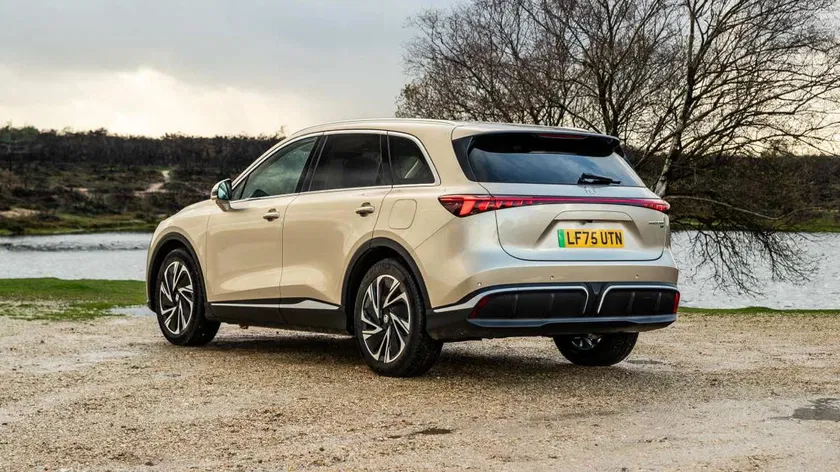
In fact, in percentual deviation, the Lucid Air Grand Tourer lost most of its energy capacity (-45.8%) just after the Opel Grandland (-45.9%). One of the contenders suffering significant capacity loss was the Volvo EX90 (-44.5%). The car sticking closest to its official figures was the MG S6 EV. It withheld 345 km from its WLTP range of 485 km, making it the only participating car to lose less than 30% of its battery range (-28.9%). Several Chinese brands (Zeekr, Voyah…) managed to contain the negative side effects from the cold, hovering slightly above the 30% threshold.


